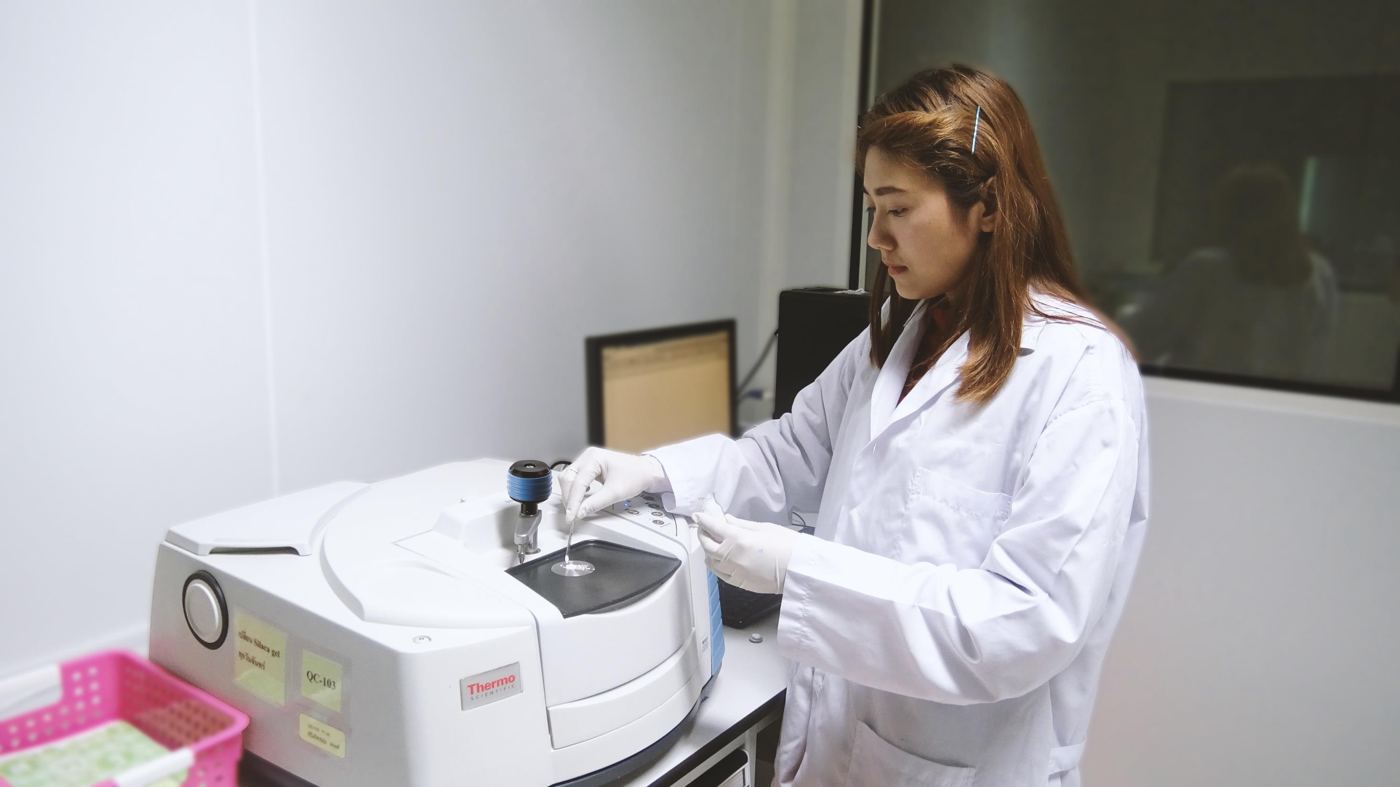
Quality Control (QC)
1. Incoming raw & packaging material inspection
Packaging materials (printed & packaging)
- Sampling plan √n+1 per ANSI Z1.4 Inspection Level II, Normal for printed material
- ANSI Z1.4 Inspection Level S-3, Normal for dimensional checks
- Inspection against printed-material and packaging specifications, with inspection records
2. In-process control
Controls during manufacture to ensure product quality meets the defined standard.
| Dosage form | Checks |
|---|---|
| Tablets | Weight, weight variation, physical appearance, hardness, thickness, friability, disintegration |
| Capsules | Weight, weight variation, physical appearance, disintegration |
| Liquids | Volume, physical appearance, pH, screw-cap closure |
| Ointments / creams / gels | Weight, physical appearance |
| Dry syrup | Weight, physical appearance, pH, screw-cap closure |
| Powders | Weight, physical appearance |
| Powder injections | Weight, physical appearance, foreign matter, aluminium cap tightness |
| Liquid injections / eye drops | Volume, physical appearance, aluminium / plastic cap tightness |
Tablet sampling example
10 tablets
Weight and physical appearance
20 tablets
Friability and weight variation (equal to the number of punches, or 20 for single punch)
5 / 6 tablets
Hardness and thickness 5 · disintegration 6 · assay from 20 ground tablets
Results are recorded in a log book and assessed pass/fail per the work instruction.
3. Instrument calibration
Instrument classification
- Instruments requiring / not requiring calibration
- Internal / external calibration
- Instrument register, calibration standards list, monthly/annual calibration plan
Internal calibration
- Notify instruments due for calibration
- QC head assigns and trains responsible staff, re-assessed every year
- Record results against acceptance criteria; attach a calibration tag when passed
Example: digital balance
- 4-decimal balance, max 200 g, calibrated every 3 months
- Up to 10 g: checked at 0.1, 0.2, 0.5, 1, 5 and 10 g
- 20 g and above: repeatability, linearity (digital reading) and off-centre loading
- Assessed against maximum permissible error, including the uncertainty of the reference weights
- Pass: calibrated tag · Fail: “do not use” tag
4. Microbiological quality control
Daily water monitoring
WFI, purified water and pure steam per USP 39: TOC, conductivity, total viable aerobic count and bacterial endotoxin.
Microbial enumeration
Raw materials and liquid, cream, ointment and gel products tested to the pharmacopoeial Microbial Limit Tests.
Agar diffusion test
Potency of antibiotics by microbiological assay, e.g. amikacin, erythromycin, gentamicin, kanamycin and lincomycin.
| Test | Purified water (PW) | WFI | Pure steam |
|---|---|---|---|
| TOC | NMT 500 ppb | ||
| Conductivity | Offline NMT 2.1 mS/cm at 25 °C · Online NMT 1.3 mS/cm at 25 °C | ||
| Total viable aerobic count | NMT 100 cfu/mL | NMT 10 cfu/100 mL | — |
| Bacterial endotoxin | — | NMT 0.25 EU/mL | NMT 0.25 EU/mL |
5. Analytical method validation & verification
| Parameter | Verification (compendial method) | Validation (new / changed method) |
|---|---|---|
| Specificity | ✓ | ✓ |
| Linearity | — | ✓ |
| Accuracy | ✓ | ✓ |
| Precision | ✓ | ✓ |
| Range | — | ✓ |
| Robustness | — | ✓ |
We also compare analytical methods across pharmacopoeias and maintain an SOP for microbiology laboratory waste disposal.