Quality Assurance (QA / QMS)
The Quality Management System (QMS) covers quality assurance of drug products, the validation master plan, change control, deviation control and quality risk management, together with batch records, recall, returns, customer complaints, media fill & environmental monitoring, process/cleaning validation, product quality review, stability and the water system.
Quality assurance of drug product
Objectives: study stability and set expiry · monitor stability of products with assigned expiry · verify manufacturing, cleaning and packing · assure quality before release.
Validation master plan (VMP)
Describes the equipment, systems and methods that require validation and the responsibilities involved — covering critical systems, processes and equipment, assessed by (1) direct impact on quality and safety, (2) direct product contact and (3) risk assessment.
Change control
A system that reviews proposals or changes that may affect product quality, keeping traceable records and assuring quality stays within standard.
Deviation control
Control of deviations during production from the set standard or plan; each must be evaluated and approved by QA.
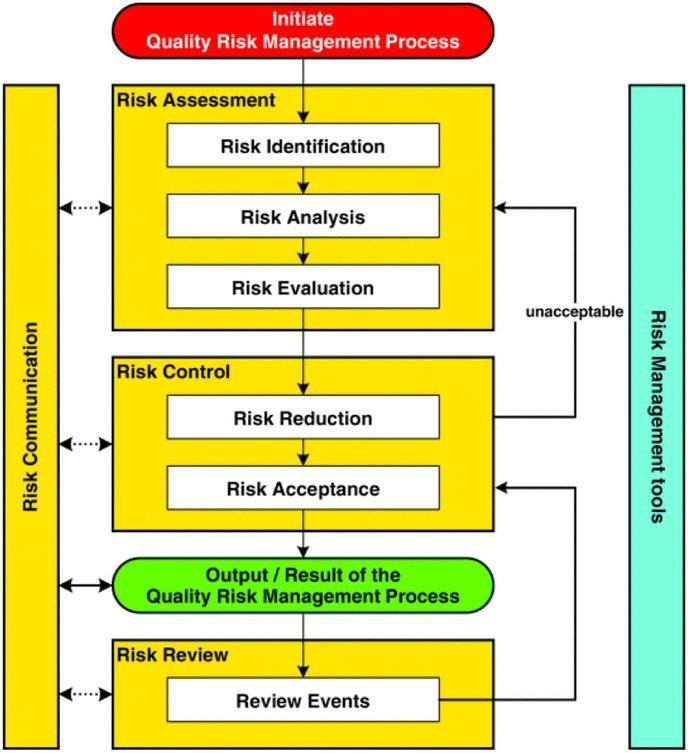
Quality risk management (ICH Q9)
A systematic process for assessing, controlling, communicating and reviewing quality risks throughout the product life cycle and prioritising them, following ICH Q9.
Batch production release
Release criteria: complete raw materials and correct weighing · process conditions within limits · batch and packing records complete and correct · in-process results within criteria · Certificate of Analysis meets specification · correct containers · QC final check correct.
Recall product
Objective: fast, effective recall that protects consumers promptly and reduces the chance of harm.
Recall ordered by the FDA
An appointment with officials is required to supervise destruction.
Voluntary recall
Destruction proceeds without an appointment; evidence with photos is submitted to the FDA.
Returned product
Manages returned and damaged products so that returns are never mixed with finished-goods stock.
Customer complaint
Complaints are used to improve product quality, delivery and service, handled efficiently and effectively to build customer satisfaction.